
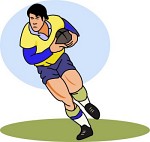
Rugby union is a fifteen-a-side team sport played with an oval ball, where the aim is to score more points than the opposition by carrying, passing and kicking the ball into the opposing team’s territory. It combines physical contact with tactical kicking and handling, and matches are contested over two 40-minute halves. The sport is now played in well over 100 countries, with international rugby drawing large crowds in England, France, New Zealand, South Africa, Ireland and Australia among others.
Objective
The basic aim is to score more points than the opposing team within the 80 minutes of play. Points come from grounding the ball in the opponent’s in-goal area for a try, or from kicking the ball between the goalposts and over the crossbar. A team can also win field position by kicking the ball into touch or forcing errors, since territory and possession usually decide who gets scoring chances.
Rules and regulations
- Players can pass the ball only sideways or backwards, never forwards, though they can kick it in any direction.
- The ball carrier can be tackled, but once tackled they must release it immediately, leading to contests known as rucks and mauls.
- Offside laws stop players standing ahead of team-mates in a way that gives them an unfair advantage near these contests.
- Foul play such as high tackles, dangerous tackling technique or foul contact with an opponent’s head is punished severely, including yellow and red cards, reflecting years of law changes aimed at reducing head injuries.
- World Rugby is the sport’s international governing body and publishes the official Laws of the Game, which are reviewed and amended periodically.
- Referees on the field are assisted by a television match official for key decisions such as tries and foul play in most top-level matches.
Equipment and playing area
- A rugby union pitch is rectangular, no more than 100 metres long between try lines with in-goal areas behind each, and up to 70 metres wide.
- H-shaped posts stand at each end, with the crossbar set at 3 metres.
- The ball is oval, made of leather or a synthetic equivalent, and slightly larger than a rugby league ball.
- Players wear jerseys, shorts and boots with studs, along with optional padded headgear and mouthguards, which are compulsory at most levels of the game.
Scoring
- A try, scored by grounding the ball in the opponent’s in-goal area, is worth 5 points and earns the scoring team a conversion attempt worth 2 more points.
- A penalty kick at goal is worth 3 points, as is a drop goal, where a player drops the ball and kicks it on the half-volley between the posts.
- These scoring values have stayed consistent for years and give teams several ways to build a winning margin even without regularly crossing the try line.