

Starting from the coast of Antarctica, a team of eight Indian Army men skied for almost 10 hours every day for 50 days, braving cold winds, snowstorms and temperatures ranging from minus 15 to minus 40 degrees Celsius, before reaching the South Pole on January 15.
Braving temperatures of minus 15 to minus 40 degrees Celsius, along with blizzards and difficult terrain, is no ordinary task. But then our ‘men in uniform’ are no ordinary people either. From fighting enemies at the border to bringing glory to the nation in the sporting arena, they have always led from the front. They combine mental and physical fitness and carry out extraordinary tasks with apparent ease.
These qualities came to the fore once again when an eight-member team led by Col Anand Swaroop crossed the difficult terrain to the South Pole and overcame every obstacle to reach the southernmost point on Earth. On January 15 the team’s skiing expedition to Antarctica reached the geographic South Pole, and the members marked the occasion by observing the 63rd Army Day there.
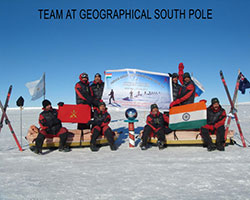
This was the Indian Army’s first coast-to-pole skiing expedition to the South Pole, covering a distance of 1,170 km. It was conceived by Lt Gen Ramesh Halgali, SM, Director General of Military Training, and was flagged off by the Chief of Army Staff, Gen VK Singh, on November 1. The journey also marked 100 years since Roald Amundsen’s first expedition to the pole.
Col Anand Swaroop, SM (Corps of Engineers), the team leader, said: “It was a great experience and a proud achievement for our country. It has made us even stronger physically and mentally. We used to ski from nine in the morning till seven in the evening. After seven, the time was ours and we used to read, play and plan for the next day. We are now hoping that more such expeditions will be planned by the Indian Army in future.”
The team for the 50-day expedition was selected after trials at the Army’s High Altitude Warfare School in Gulmarg, Jammu and Kashmir. To prepare the team realistically for polar conditions, a rigorous one-month pre-expedition training camp was held in Greenland from August 29 to September 28 last year to familiarise the members with sub-zero temperatures like those of Antarctica.
The team and its equipment flew to Antarctica on a mix of commercial and chartered flights. The expedition took the Hercules Inlet route, which involved skiing from the coast of Antarctica to the South Pole at 90 degrees latitude.
The members pulled sledges carrying supplies for nearly two months and were self-sufficient until they reached the South Pole. Along the way they faced extreme cold, with temperatures between minus 15 and minus 40 degrees Celsius.
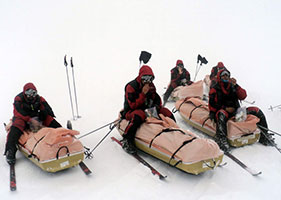
“The biggest challenge for us was not fighting the weather conditions and other adversities, but maintaining our mental balance till the end of the expedition. Being so far from home tends to break your spirit at some point, but this was something we had to deal with bravely. I’m happy that each one of us overcame the barriers and accomplished the task,” said Capt R Bala Karthik, SC (Special Forces), the deputy team leader, who has also been awarded the Shaurya Chakra for bravery.
“It was very difficult to predict the weather there, as it used to change every few hours. We would start in bright sunshine and barely half an hour later a storm would come up. But we never stopped and kept going,” said the members of the team.
Being uninhabited, the South Pole is the least polluted area on Earth. It is also known as the Earth’s window to outer space and is one of the best places to study meteorology, earth science and glaciology and to carry out other scientific research.
The expedition was flagged in by Defence Minister AK Antony at South Block on March 1. During the ceremony, the minister praised the efforts of the expedition members and congratulated the Indian Army on another remarkable feat in adventure training. He added that the expedition would increase awareness of the South Pole among Indians and set a trend for other adventure enthusiasts to follow.
Over the last decade, Army mountaineering teams have hoisted the Indian flag on the six highest peaks in the Himalayas.
“I am really happy to learn that the Indian Army team successfully hoisted the Indian flag at the South Pole on Army Day this year. I extend my heartiest congratulations to all the members of the expedition on this proud achievement,” said Antony.
The Indian Army has been a pioneer and trendsetter in adventure sports and activities in India. All its adventure activities are organised and managed by the Army Adventure Wing under the Director General of Military Training.
The members of the team
- Col Anand Swaroop, SM (Corps of Engineers): team leader. He has qualified in the basic and advanced mountaineering courses at HMI, Darjeeling, and NIM, Uttarkashi, and has taken part in several mountaineering expeditions.
- Capt R Bala Krishnan, SC (Special Forces): deputy team leader. An alumnus of Sainik School, Amaravathinagar, the NDA and the IMA, he is a Shaurya Chakra holder.
- L/Nk Khilap Singh (Garhwal Rifles): excelled in mountaineering courses at the High Altitude Warfare School and has taken part in mountaineering expeditions. He was the official photographer of the expedition.
- L/Nk Arjun Kumar Thapa (Gorkha Regiment): a Gorkhali who has climbed Leo Pargial and Kinner Kailash.
- L/Nk Parsuram Gurung (Para Field Artillery): a gunner from Arunachal Pradesh. He summited Stok Kangri in 2009.
- Rfn Tsewang Morup (Ladakh Scouts): from Ladakh, he was the team’s doctor.
- Rfn Ram Singh (Garhwal Rifles): from Garhwal, he excelled in the High Altitude Warfare School courses and was the communications expert on the expedition.
- Rfn Shaukat Ahmed Mir: a Kashmiri member of the ski team who took part in the National Alpine Ski Championship in 2006 and 2009.
By Akshi Aggarwal
Indian Sports News