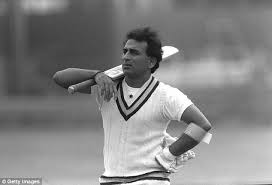
Sunil Gavaskar was the first batter in history to reach 10,000 Test runs, and for a generation of Indian cricket followers he was the reason a Test match was worth switching on the radio for. Short, compact and almost impossible to dislodge, he opened the batting against the fastest bowling attacks of the 1970s and 1980s without a helmet for much of his career, and finished with 34 Test centuries, a world record at the time of his retirement.
Name: Sunil Manohar Gavaskar | Born: 10 July 1949, Bombay | Sport: Cricket | Position: Right-handed opening batter
A Bombay schoolboy with a defence to match
Gavaskar grew up in Bombay, a city with a long tradition of producing Test batters, and he learned the game on its crowded maidans where getting out cheaply meant a long wait for another turn. He made his first-class debut for Bombay in 1967 and was soon scoring heavily in a Ranji Trophy side that was used to winning. What marked him out early was not power but judgement. He left the ball outside off stump with a calm that bowlers found maddening, and his footwork was neat enough to get him in line with almost anything.
He would play for Bombay from 1967 to 1982, and later spent the 1980 English summer with Somerset in county cricket.
The debut series that made his name
Few Test careers have begun the way Gavaskar’s did. He was picked for the 1970-71 tour of the West Indies and made his debut at the Queen’s Park Oval in Port of Spain on 6 March 1971. Over four Tests he scored 774 runs at an average of 154.80, still the most by any batter in a debut series. In the final Test, also in Port of Spain, he made 124 and 220 in the same match. India won the series 1-0, their first series victory in the Caribbean, and the 21-year-old opener came home a national figure.
That series also shaped how he would be judged. West Indies were not yet the four-pronged pace machine they became, but the lesson was clear: here was a batter who could bat for hours against good bowling on hostile pitches and come out the other side with a hundred.
Long innings in England and the Oval chase
England was a harder place for Indian batters in that era, yet Gavaskar’s most celebrated innings there came in a match India did not win. At the Oval in 1979, India were set 438 to win in the fourth innings. Gavaskar and Chetan Chauhan put on 213 for the first wicket and Gavaskar went on to complete his third Test double century. When he was finally caught by David Gower off Ian Botham, India were 389 for 4 and in sight of an extraordinary victory. They finished on 429 for 8, nine runs short, and the match was drawn. It remains one of the great fourth-innings efforts in Test cricket.
There was another side to his record in limited-overs cricket, which he never fully took to. His unbeaten 36 off the full 60 overs against England in the 1975 World Cup is still discussed for the wrong reasons. Yet he adapted with time, made 3,092 runs in 108 one-day internationals and scored an unbeaten 103 in the 1987 World Cup, his only century in the format.
Passing Bradman and the 10,000 mark
The early 1980s brought the milestones. Against West Indies in 1983-84, at that point the strongest side in the world, Gavaskar made 121 at Delhi to draw level with Sir Don Bradman’s 29 Test hundreds. Later in the same series at Madras he scored an unbeaten 236, his highest Test score and his 30th century, moving past Bradman on the all-time list.
The next landmark came in the 1986-87 home series against Pakistan. In the fourth Test at Ahmedabad, Gavaskar scored 63 and became the first player to reach 10,000 Test runs. His final Test came at Bangalore in March 1987, on a turning pitch against Pakistan’s spinners. India lost narrowly, but Gavaskar’s 96 in the second innings is still regarded by many who played in it as one of the finest technical innings seen on a bad surface.
Captaincy and leadership
Gavaskar first led India in a Test against New Zealand at Auckland in January 1976 and had several spells in charge over the following decade. He was a cautious, tactically sharp captain, and while Test results under him were mixed, he led India to the 1984 Asia Cup and to the 1985 World Championship of Cricket in Australia, where India won every match. He was a member of the squad that won the 1983 World Cup under Kapil Dev.
Life after playing
Retirement did not take him far from the game. Gavaskar became one of the best-known voices in cricket broadcasting, a columnist and an author whose books include Sunny Days (1976), Idols (1983), Runs ‘n Ruins (1984) and One Day Wonders (1986). Since 1996, Test series between India and Australia have been played for the Border-Gavaskar Trophy, named after him and Allan Border.
His standing in the game was recognised formally many times. He was named a Wisden Cricketer of the Year in 1980, the same year he received the Padma Bhushan, and he was inducted into the ICC Cricket Hall of Fame in 2009. The BCCI presented him with the Col. C. K. Nayudu Lifetime Achievement Award in 2012.
Career record and honours
- Tests: 125 matches, 10,122 runs, average 51.12, 34 centuries, 45 fifties, highest score 236 not out
- One-day internationals: 108 matches, 3,092 runs, average 35.13, one century
- Test debut: 6 March 1971 v West Indies, Port of Spain
- First batter to reach 10,000 Test runs (Ahmedabad, 1986-87)
- 774 runs in his debut series, 1970-71 in the West Indies
- World Cup winner, 1983; captain of the winning side at the 1985 World Championship of Cricket and the 1984 Asia Cup
- Arjuna Award
- Padma Bhushan, 1980
- Wisden Cricketer of the Year, 1980
- ICC Cricket Hall of Fame, 2009
- Col. C. K. Nayudu Lifetime Achievement Award, 2012