
Pesäpallo is often called Finnish baseball, though anyone expecting a diamond and a pitcher’s mound will be surprised. Invented in the 1920s and now the national sport of Finland, it swaps baseball’s straight base paths for a zigzag route and its overarm pitch for a ball tossed straight up. The domestic game is run by Pesäpalloliitto, the Finnish Baseball Association, while international matches and World Cups fall under the sport’s own international federation.
Objective
One team bats while the other fields, just as in baseball. The batting side tries to hit the ball into play and run around a set of bases without being tagged out, while the fielding side tries to catch the ball, restrict runs and get batters out.
Rules and regulations
- A team fields nine players at a time, while the batting side has 12 players available across the game, including a few used specifically as substitute runners.
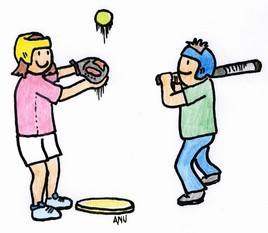
- Instead of a pitcher throwing across the plate, the “pitcher” stands beside the batter and tosses the ball straight upward, at least a metre above their own head, and the batter strikes it as it comes down.
- A batter gets three attempts to put the ball into fair territory.
- The bases are laid out in an irregular zigzag rather than a square, so a batter who reaches every base on one hit, without needing to stop, is credited with the equivalent of a home run.
- A full game is usually split into two periods of four innings each, with the side batting last given a shorter final innings if they’re already ahead.
Equipment and playing area
- Players use a narrow, rounded bat no longer than a metre, often made from modern composite materials rather than wood, and a small yellow ball.
- Fielders wear thick gloves and, since safety rules were tightened after a fatal accident in the 1980s, helmets are compulsory for everyone on the field, both batting and fielding.
- The pitch is roughly pentagonal, laid out with home plate at one point and the zigzag bases marked by lines rather than physical bags.
Scoring
- Runs are scored when a batter or runner completes the full circuit of bases and returns to home without being tagged out or forced out.
- The team with more runs at the end of the match wins, and a tied game can go to an extra, sudden-death innings.