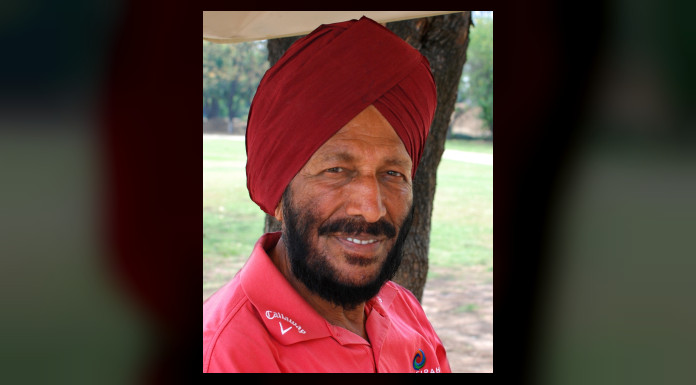
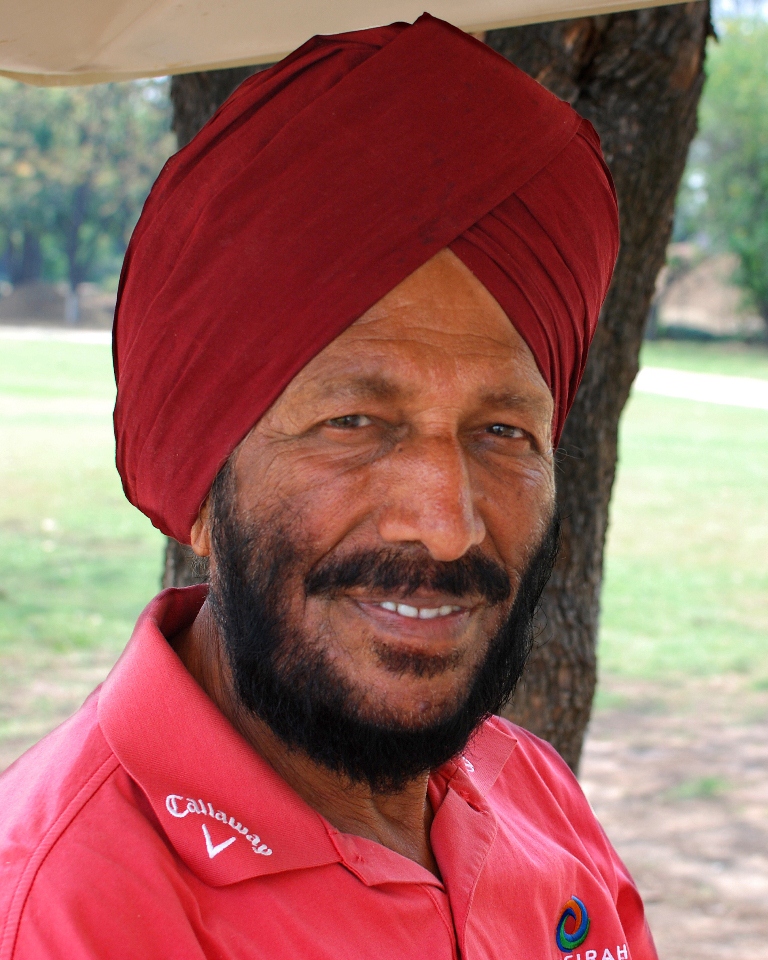
 Name: Milkha Singh
Born: 20 November 1929, Govindpura, Punjab (now in Pakistan)
Died: 18 June 2021, Chandigarh
Sport: Athletics (400m)
Early life
Milkha Singh was orphaned during Partition, losing his parents and two siblings, and reached Delhi as a refugee in 1947. He was briefly imprisoned in Tihar jail for travelling without a ticket, and his sister Ishvar sold her jewellery to secure his release. Disillusioned, he considered turning to crime before his brother Malkhan persuaded him to try for the Indian Army; he was accepted on his fourth attempt, in 1951.
Career
He took up running at the Electrical Mechanical Engineering Centre in Secunderabad and represented India in the 200m and 400m at the 1956 Melbourne Olympics, though he failed to get past the heats. At the 1958 National Games in Cuttack he set new marks in both events, and that year he won gold in the 200m and 400m at the Asian Games in Tokyo. At the 1958 Commonwealth Games in Cardiff he won the 440 yards in 46.6 seconds, the first individual athletics gold for independent India at the Games; he was promoted from sepoy to junior commissioned officer in recognition, and later given the honorary rank of Captain. In 1960 he won the British AAA title, going through that year unbeaten in the 400m against international opposition.
Rome, 1960
His best-remembered race is the 400m final at the 1960 Rome Olympics. He led into the home straight before easing off and looking round at his rivals, and finished fourth in 45.6 seconds (45.73 by electronic timing) – one tenth of a second outside the medals, behind winner Otis Davis of the United States, who set a world record of 44.9 seconds. Singh’s time stood as the Indian national record for close to 40 years and remains one of the fastest 400m runs by an Indian. He added a 400m gold and a 4x400m relay gold at the 1962 Asian Games in Jakarta, and competed at a fourth Olympics, in Tokyo in 1964, without completing the 400m. Across his career he won eight golds and a silver across the Asian Games, Commonwealth Games and National Games. The nickname “Flying Sikh” is said to date from a race in Pakistan around 1960, after President Ayub Khan told him: “You didn’t run today, you flew.”
Later life
After the Army, he became Director of Sports for Punjab’s Ministry of Education, retiring in 1998. In 2001 he turned down the Arjuna Award, saying it was intended for younger athletes and had been devalued: he compared it to being offered a school certificate after already earning a Master’s degree. He married Nirmal Saini, captain of India’s national volleyball team, and the couple had three daughters and a son, golfer Jeev Milkha Singh; in 1999 they adopted a seven-year-old boy whose father, a soldier, had died in the Kargil war. His autobiography, The Race of My Life, written with his daughter Sonia Sanwalka, was published in 2013, the same year his life story became the film Bhaag Milkha Bhaag, starring Farhan Akhtar. He sold the film rights for one rupee on condition that profits went to the Milkha Singh Charitable Trust, which he had founded in 2003; the film took more than ₹100 crore at the box office and won the National Film Award for Best Popular Film and five awards at the 2014 IIFA ceremony. A wax statue of him in his 1958 Commonwealth Games running pose was unveiled at Madame Tussauds Delhi in 2017. He died of complications from COVID-19 in June 2021, five days after his wife died of the same illness; Olympic javelin champion Neeraj Chopra dedicated his 2020 Tokyo gold medal to Singh’s memory.
Achievements and awards
Padma Shri (1959), Helms World Trophy for Asia (1959), Bharat Gaurav Award (2016).
Photo: Wikimedia Commons