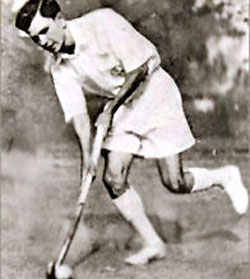
Name: Leslie Walter Claudius
Born: 25 March 1927, Bilaspur
Died: 20 December 2012, Kolkata
State: Madhya Pradesh
Sport: Hockey
Early life
Leslie Claudius was born into an Anglo-Indian family in Bilaspur, one of nine children, and was educated at the South Eastern Railway English Medium School there, an institution that produced a string of national-level athletes. He started out as a footballer, playing as a left-half for the Bengal Nagpur Railway team in the Indian Football Association Shield, and it was Dickie Carr, a member of India’s 1936 Olympic gold-medal hockey team, who spotted his talent and steered him towards hockey instead, a switch that would in time make him far more famous in his second sport than he had ever been in his first.
An unlikely Olympic debut
Claudius had been playing hockey for barely two years when, at the age of twenty-one, he impressed at the trials after a strong showing for the Port Commissioner’s team in the 1948 Aga Khan Tournament in Bombay. He was picked for the London Olympics that year and played in just one match, but it was enough: India won gold as an independent nation for the first time, and Claudius had begun a run that would make him one of the most decorated hockey players in Olympic history, all from a debut appearance he could hardly have anticipated two years earlier when he was still lining up as a footballer.
Four Olympics in a row
Claudius went on to win gold at the 1952 Helsinki and 1956 Melbourne Olympics as well, completing a hat-trick, before captaining the side to silver at the 1960 Rome Olympics, where India’s remarkable run of thirty consecutive Olympic victories since 1928 finally came to an end in the final against Pakistan. Across those four Games he became the first player to earn 100 international caps, and he shares with Udham Singh the distinction of having won four Olympic hockey medals, a feat recorded in the Guinness Book of World Records.
Captain and later career
Claudius was named captain of the Indian team in 1959, with Dhyan Chand serving as coach, and led the side on a European tour in which they won 15 of 19 matches. He also toured with India to Malaysia, Australia and New Zealand, and played at the 1958 Asian Games in Tokyo, where India took silver, adding still further to a playing record that already ranked among the most extensive of any hockey player of his generation. He continued playing domestic hockey for Bengal and Calcutta Customs until retiring in 1965, alongside a career with the Calcutta Customs Department, where he eventually rose to Assistant Collector of Customs.
Family and death
Claudius married and had four sons; one of them, Robert “Bobby” Claudius, played for India at the 1978 Hockey World Cup before his own death in a road accident in Kolkata that same year. Leslie Claudius later served the Indian hockey set-up as a team manager at the 1974 and 1978 Asian Games and sat on the Hockey Federation’s selection panel, a second career spent helping shape the teams that followed the one he had led. He died in Kolkata on 20 December 2012, after a long illness, and is buried at the Lower Circular Road cemetery in the city; a road in Kolkata, Leslie Claudius Sarani, was later named in his memory, a lasting reminder of a career that had spanned four Olympic Games.
Achievements and awards
Gold medallist, 1948 London, 1952 Helsinki and 1956 Melbourne Olympics; silver medallist and captain, 1960 Rome Olympics; first hockey player to reach 100 international caps; four Olympic hockey medals, a Guinness World Record shared with Udham Singh; captain of India, from 1959; Padma Shri, 1971; Banga Bibhushan, 2012; road named in his honour in Kolkata, 2015.