

Name: Kunwar Digvijay Singh, known as K.D. Singh “Babu”
Born: 2 February 1922, Barabanki
Died: 27 March 1978
State: Uttar Pradesh
Sport: Hockey
Early life
Kunwar Digvijay Singh, known throughout Indian hockey simply as “Babu”, grew up in Barabanki and was educated at the Government High School there before moving on to Kanyakubj Inter College in Lucknow. He first showed his ability at a village tournament at Dewa Mela, and by the age of fifteen, playing for the LYA Club in Lucknow at the Traders Cup in Delhi, he had already caught the eye of the Olympian Mohammed Hussain, who predicted the teenager would become one of the finest players the game had seen, a forecast that looked prescient within only a few seasons.
An artist with the stick
Babu represented Uttar Pradesh in national tournaments continuously from 1939 to 1959, a remarkable span, and was known above all for a touch and vision that made him one of the most gifted inside-forwards of his era, capable of drawing defenders out of position with a single feint before slipping a pass through the gap he had created. On an East Africa tour in 1947, playing alongside the legendary Dhyan Chand, he actually outscored him, netting 70 goals to Chand’s 62, and the following year he scored 99 of India’s 236 goals in domestic competition, the highest individual tally in the country.
London, 1948
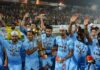
Babu was selected as vice-captain of the Indian team for the 1948 London Olympics, the country’s first appearance at the Games as an independent nation. He scored four goals across the tournament, including a crucial strike in the semi-final against the Netherlands, and his performances drew praise from the British press, with one newspaper calling his dribbling and passing “as near to perfection as was possible.” India won gold, a result laden with symbolism for a country only recently freed from colonial rule, and Babu’s role in that victory helped establish him as a national sporting figure in his own right, rather than simply a promising young player in the shadow of more famous teammates.
Captain in Helsinki
By the 1952 Helsinki Olympics, Babu had been made captain of the side, and he led India to a second consecutive gold medal, scoring in both the quarter-final and the final against the Netherlands. His performances at those Games, full of clever touches and quick decision-making under pressure, prompted New Zealand’s captain to describe his play as “poetry in motion,” and in 1953 he became the first Indian to receive the Helms Trophy, an American honour often likened to a Nobel Prize for sport, awarded to the best hockey player in the world for 1952 and the best sportsman in Asia for 1953.
Later career and death
After retiring from playing, Babu coached the Indian hockey team at the 1972 Munich Olympics and served on a number of sporting and public bodies, including the All India Council of Sports, the Railway Board, the Rifle Association of India and the Uttar Pradesh Wildlife Protection Committee. He died on 27 March 1978, at the age of 56, from a gunshot wound; contemporaries said he had been troubled by personal difficulties in the period before his death, a sombre end to a life that had brought India two Olympic golds and a reputation as one of the finest hockey players the country had produced.
Achievements and awards
Gold medallist and vice-captain, 1948 London Olympics; gold medallist and captain, 1952 Helsinki Olympics; first Indian to receive the Helms Trophy, 1953, for the best hockey player in the world and best sportsman of Asia; Padma Shri, 1958; coach, Indian hockey team, 1972 Munich Olympics; stadiums in both Lucknow and Barabanki named in his honour.