

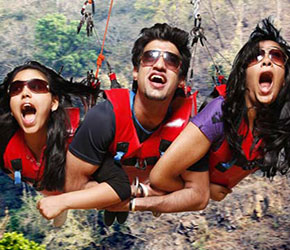
Samikshan Dutta Choudhury describes his bungee jump in Rishikesh, which he calls the experience of his life.
Nothing is more psychedelic than getting high from falling. It is a feeling alien to most of us, and to get acquainted with it you have to go through the fun-filled, nerve-racking extreme adventure sport called bungee jumping.
Bungee jumping will make you forget every definition of fear and terror you have ever understood. When you first see the set-up, it can look like a gimmick dreamt up by thrill-seekers for a little hype. But once you have actually done it, you realise it was the time of your life.
If you want to have this experience, Rishikesh is waiting to welcome you. Jumping Heights, India’s first registered extreme adventure zone, has a bungee platform of 83 metres, and the whole setting is bold enough.
The walk to the edge
After a fun-filled drive along the Ganges in a bungee coach to the site, which is an adventure in itself, you reach the place where the platform stands at a mammoth height. It is reason enough to make you feel nauseous, and it is not even the beginning of what you will go through in the minutes to come.
A few small formalities are completed before the jump to ensure your safety. After that you are led to the site. Walking on the shaky cantilever, made of more than 1,000 tonnes of steel, you start to have doubts. It is not because of the platform, which is firm enough to hold a tank, but because of the surroundings. The jumping point is surrounded by hills on all sides, and below it is a rocky river.
Waiting for your turn and watching other people make exhilarating jumps, you get excited, but the excitement also makes you more anxious about what lies ahead. Finally it is your turn to get ready, and you are harnessed for the jump. Two body harnesses are fitted for extra safety, and a rope suited to your body weight is tied to your leg. These procedures pump you up. You are all set. But when you are guided to the edge of the cantilever, you realise what the word ‘height’ really means. Standing at more than 80 metres, you know that in a moment you will be playing with madness. Before you are mentally prepared, all kinds of thoughts run through your mind, and they can work against the whole idea of jumping.
You need to conquer all that and pull yourself together. The jumpmasters from abroad start talking to you to prepare you mentally. You hardly take in what they are saying, because your nervous system is busy reacting to other stimuli: a racing heart, tremors and rising blood pressure. While you are fighting the demons within, the countdown begins and everybody around starts cheering for you. At that point it is one way or the other. So you jump, conquering everything.
The fall
Once you leave the cantilever and are in free fall, not a single word comes out of your mouth. Only when the rope catches you and you realise you are safe do you scream your guts out, because you have done something that seemed impossible. While you swing upside down like a yo-yo, your only link with the world above is the cord, which you want to hold on to as if it were your baby.
There is a misconception that the jump produces a painful bouncing effect. It is not true, at least until the next day. You are so caught up in the feeling that pain cannot even tickle you. After falling about 83 metres (272 feet) and reaching the end of the rope within seconds, having stretched your adventurous streak to the limit, you want to be lowered, because now you want to tell the tale to the world. The crew obliges, and the rope is lowered.
When it is all over, you are still shaking from the adrenaline, and you stay high on it for the rest of the day. There was life before the jump, and there is life after the jump. You want to watch other people jump and share your experience with them. It is different for everyone, but the one thing common to everyone who has jumped is that it remains the jump of their life.

Extreme adventure calling in Rishikesh
Jumping Heights has set up India’s first ‘Extreme Adventure Zone’ in Rishikesh. The site is at Mohanchatti, a 15km drive from Lakshman Jhula, and is surrounded by mountains and rivers.
Jumping Heights has three things to offer adventure lovers: Asia’s longest Flying Fox, a Giant Swing of 83 metres and the mother of all bungee jumps, from a height of 83 metres. The site was designed by staff from New Zealand and is of world-class quality. Alongside Indians, the crew includes staff from New Zealand with wide experience in adventure sports. The crew has undergone extensive training, and the best equipment and procedures are in place.
Jumping Heights is India’s first registered adventure zone. The bungee jump, made from a cantilever at 83 metres, is one of its kind in the world. A businessman from Ujjain said, “I travelled all the way from Ujjain, which is a 12-hour drive. I have come to take the jump and I would do it again. I heard about the place from my friend. The safety standards are good, so I am not at all worried.”
The Flying Fox starts from a height of 120 metres and is 1km long, the longest in Asia. It travels at a speed of 160km/h. An engineer from Ujjain said, “I have a lot of cars, but this is the best ride I have ever had.” The Flying Fox was designed by Ron Craston.
It took a long time to set up the venture. In an interview with Samikshan Dutta Choudhury, Vivek Sethi, the official spokesperson of Jumping Heights, talks about the effort that went into it.
ISN: How long has Jumping Heights been in operation?
Vivek: Commercially since 1 June 2010, but the advertising started only in November.
ISN: How did you come up with the idea?
Vivek: The passion to give India world-class facilities in its own backyard was what motivated us. We went to New Zealand and did extensive research. We conducted geological surveys and site visits before setting up. We had to go through a lot of hard work.
ISN: What were the initial hassles?
Vivek: We had lots of hassles initially. We faced delays in government clearances, but the major one was local resistance, which was sorted out because all our employees are locals, except the jumpmasters.
ISN: Apart from adventure lovers, has such a large project benefited anyone else?
Vivek: Let me make one thing clear: it has not helped us financially at all. Apart from benefiting adventure lovers, it has helped tourism in Rishikesh and given the town a new tag as an adventure sports zone. It has also helped local people, as we employ only people from the area.
ISN: How safe is your zone?
Vivek: It is very safe. Touch wood, nothing has happened so far and nothing will happen in the future either. Before any activity, the person is given one body harness and then two additional supports in case the first one fails. So it is completely secure. It is 100 per cent safe.
ISN: What is your workforce?
Vivek: Two jumpmasters from New Zealand and 43 local employees.
ISN: What is your vision?
Vivek: Ten years down the line, we want to be operating in five more places. The pace of acceptance will change. We want to put India on the adventure map.