
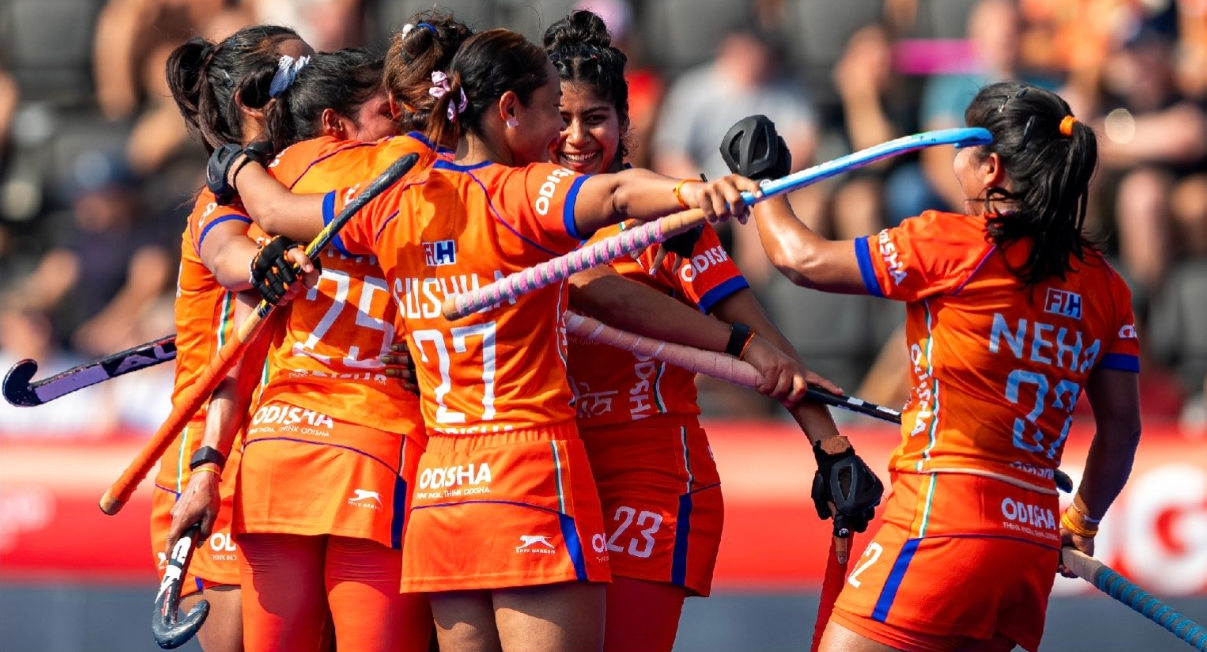
India’s women’s hockey team beat Germany 3-1 in Amstelveen on 27 August to finish fifth at the FIH Hockey World Cup, their best finish in 52 years. Navneet Kaur scored twice, Ishika added the opener, and a squad with 11 World Cup debutants had done something no Indian women’s side had managed since the inaugural tournament in 1974. It is a genuinely good result. It is also, on its own, not worth very much unless India can do something with it.
That is not a knock on the achievement. It is more or less what the team’s own coach said, in his own way, minutes after the final whistle. “Of course I am satisfied, but I am also a coach who always demands more,” Sjoerd Marijne said. “What the girls have achieved, they have rewritten history.” He did not stop there. “We need to work on consistency,” he added, pointing to a campaign that swung between a 6-1 win over South Africa, goalless draws with England and Australia, a 2-2 draw with China, and a 0-2 defeat to hosts Netherlands – the only match India lost all tournament. A coach who has just delivered his team’s best World Cup finish in five decades does not bring up consistency unless he means it.
A young side, and the question that comes with it
Eleven debutants in a World Cup squad is either a promising sign or a worrying one, depending on what happens next. Marijne, asked about his standout performers, refused to name any. “Not one player, it is one team. I am not going to name anyone,” he said, before adding: “It is a young team and they are amazing.” That is a coach protecting a group, and fairly so. But it also means India’s fifth-place finish was not built around two or three proven match-winners the way some campaigns are. It was collective, which is encouraging for depth and slightly harder to repeat on demand.
Marijne has been here before with this team, in a different way. He was head coach when India reached fourth place at the Tokyo Olympics five years ago, still their best Olympic result, then left the job before returning in January this year ahead of the Commonwealth Games, this World Cup and the Asian Games. Between his two spells, Janneke Schopman had charge of the side – and it was Schopman, coaching Germany, who stood on the opposite bench in the fifth-place play-off. Continuity of a kind, even in defeat for one of them.
What captain and federation are saying
Salima Tete had set the bar before the tournament even began, saying India wanted to play the final. They did not get there, but nobody at Hockey India sounded disappointed. President Padma Dilip Tirkey called it “a historic result for Indian women’s hockey,” adding: “To finish fifth at a World Cup after 52 years is a testament to the hard work, resilience and fighting spirit this team has shown throughout the tournament.” Secretary general Bhola Nath Singh went further, crediting Tete and her side for a campaign “that saw them compete with, and hold their own against, some of the best sides in the world.” Hockey India followed the words with money – a Rs 50 lakh cash award for the squad.
None of that is in question. The more useful question is what the federation does after the cheque is written. A one-off reward is easy. Keeping a squad of debutants together, fit and improving through an Asian Games, a Pro League season and whatever Olympic qualification route follows is the harder and less visible work, and it is that work, not the size of the bonus, that will decide whether fifth place turns out to be a floor or a ceiling for this team.
Aichi-Nagoya is the real test
India do not have long to find out. The Asian Games in Aichi-Nagoya are this month, and Marijne has already set the tone for it: “We need to recover now and take this new good experience to the next tournament,” he said, adding that India’s approach would be “90 per cent about ourselves. We won’t focus on the opponents.” That is a coach trying to stop his team from either coasting on the World Cup high or being overawed by it.
The Asian Games matter for more than a medal. Women’s hockey at the Los Angeles 2028 Olympics will have 12 qualifying spots, filled through a host quota for the United States, places for the top two teams across the next two FIH Pro League seasons, one spot for the winner of each continental championship – Asia’s included – and a final round of Olympic qualification tournaments in early 2028. Win gold in Aichi-Nagoya and India go a long way toward settling their Los Angeles qualification without having to survive that last, congested route in 2028. That is arguably a bigger prize than the World Cup medal table position India have just improved.
The honest way to judge this
The temptation after a result like this is to talk about a turning point, a golden generation, a team arriving. Marijne himself is not doing that, and there is no good reason for anyone else to do it for him. What India have shown in Amstelveen is that a young, largely untested squad can hold its own against higher-ranked opposition, lose to only the tournament’s eventual silver medallists, and finish the job when it mattered against a team ranked above them. What they have not yet shown is that they can do it twice.
That is the fair standard to hold this team to now – not whether Aichi-Nagoya produces another headline, but whether the consistency Marijne asked for actually shows up. Tete wanted a final in Amstelveen and didn’t get one. The next honest question for India’s women is whether they can go one tournament further than fifth, not just once, but as a matter of course.