
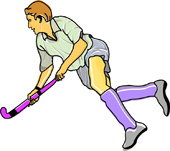
Field hockey is one of the oldest team sports still played at international level, and in India it carries a history few other games can match, from the Olympic golds of the 1920s to ’60s to the modern national team’s recent medal-winning runs. The game is played on a flat pitch with a small, hard ball and curved sticks, and it rewards quick passing, sharp positional sense and stamina over four fast quarters.
Objective
Two teams try to hit, push or flick the ball into the opponent’s goal more times than the other side manages in the time allowed. Unlike football, there’s no offside rule in hockey, so attackers can push forward and wait for a pass without being penalised for their position.
Rules and regulations
- A match is run by the International Hockey Federation, known as the FIH, and lasts four quarters of 15 minutes each, with short two-minute breaks after the first and third quarters and a longer ten-minute interval at half-time.
- Only players’ sticks may touch the ball; using feet, hands or the body to control it gives away a free hit to the other side, except for the goalkeeper inside their own shooting circle.
- Sticks can only be used on their flat left-hand face, and raising the stick dangerously near another player is punished.
- Fouls inside the circle often lead to a penalty corner, a set play in which the ball is passed out from the goal line and a defender rushes out to close down the shot.
- Serious or repeated offences bring cards: green for a warning, yellow for a temporary spell off the pitch, and red for a permanent send-off.
- If a knockout match is level after full time, it’s settled by a shoot-out, where each team’s chosen players get eight seconds, one at a time, to beat the goalkeeper from the 23-metre line.
Equipment and playing area
- The pitch measures roughly 91.4 metres by 55 metres and is usually an artificial, water-based surface these days rather than grass.
- Each team fields eleven players, including a goalkeeper who wears full protective padding and a helmet.
- Outfield players use a wooden or composite stick with a curved head, and the ball is made of hard plastic.
- Goals stand two metres high and 3.66 metres wide, sitting inside a D-shaped shooting circle 14.63 metres from the goal line.
Scoring
- A goal counts only if the ball is touched by an attacking player’s stick while it is inside the shooting circle before crossing the line.
- A shot struck from outside that circle, even if it flies straight into the goal, doesn’t count.
- Whichever team scores more goals across the four quarters wins; if scores are tied in a league match, it usually ends as a draw, while knockout ties move to the shoot-out.