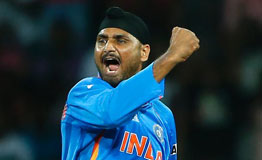
Harbhajan Singh took 417 Test wickets, the most by any Indian off-spinner, and announced himself in March 2001 with 32 wickets in three Tests against Australia, including the first Test hat-trick by an Indian. Combative and quick-witted, the bowler from Jalandhar won the World T20 in 2007 and the World Cup in 2011, and later entered the Rajya Sabha.
Name: Harbhajan Singh | Born: 3 July 1980, Jalandhar, Punjab | Sport: Cricket | Position: Right-arm off-spin bowler, lower-order batter
An early start
Harbhajan began as a batter in Jalandhar before his coach turned him towards off-spin. He developed quickly and was in the India side as a teenager, making his Test debut against Australia on 25 March 1998 and his one-day debut against New Zealand on 17 April 1998. The next couple of years were difficult. Questions were raised about his action, he had disciplinary trouble at the National Cricket Academy, and he spent time out of the side working on his game.
The 2001 series against Australia
He was recalled for the home series against Steve Waugh’s Australians in early 2001, largely because Anil Kumble was injured and Sourav Ganguly pushed for his inclusion. What followed changed his career. In the second Test at Eden Gardens he dismissed Ricky Ponting, Adam Gilchrist and Shane Warne with consecutive balls for India’s first Test hat-trick, and he bowled India to victory on the final day after they had followed on. In the deciding Test at Chennai he took 15 wickets in the match as India won by two wickets.
He finished the three-match series with 32 wickets at 17.03. India won 2-1 and ended Australia’s run of 16 straight Test wins.
Bounce, drift and the doosra
Harbhajan was not a classical, flighted off-spinner. He bowled at a brisk pace with a whippy action and got sharp bounce, which made him very hard to play on Indian pitches and useful even on harder surfaces abroad. Through the 2000s he added a doosra, the ball that turns away from the right-hander. For long stretches he and Kumble bowled in tandem, and after Kumble retired in 2008 Harbhajan became India’s main spinner. His best Test figures, eight for 84, came against Australia in Chennai in that 2001 series, and he took 25 five-wicket hauls in all.
Runs as well as wickets
His batting became a real asset. In November 2010 he scored his first Test hundred, 115 against New Zealand at Ahmedabad, and followed it with an unbeaten 111 in the next Test at Hyderabad. Both innings came from the lower middle order and both helped India draw matches against a determined New Zealand side.
White-ball titles
In one-day cricket he took 269 wickets in 236 matches, with a best of five for 31. He was part of the side that won the first World T20 in South Africa in 2007 and played in India’s 2011 World Cup-winning team. In the Indian Premier League he spent ten seasons with Mumbai Indians, captaining them to the Champions League T20 title in 2011, before moving to Chennai Super Kings and later Kolkata Knight Riders.
His career also had its controversies, including the dispute during the Sydney Test of January 2008 and a ban for slapping S. Sreesanth during the first IPL season. He played his final Test in 2015.
Retirement and public life
Harbhajan announced his retirement from all forms of cricket on 24 December 2021, after 23 years at the top level. In April 2022 he took his seat in the Rajya Sabha as a member from Punjab. He has also worked as a television commentator and appeared in films.
Career record and honours
- Tests: 103 matches, 417 wickets, average 32.46, 25 five-wicket hauls, best figures 8 for 84
- Test hundreds: 115 and 111 not out against New Zealand, 2010
- One-day internationals: 236 matches, 269 wickets, best figures 5 for 31
- T20 internationals: 28 matches, 25 wickets, best figures 4 for 12
- 32 wickets at 17.03 in the 2001 series against Australia, including India’s first Test hat-trick
- World T20 winner 2007; World Cup winner 2011
- Champions League T20 winner as Mumbai Indians captain, 2011
- Arjuna Award: 2003
- Padma Shri: 2009
- Member of the Rajya Sabha from April 2022