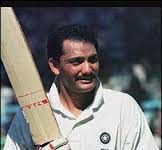
Dilip Vengsarkar was the tall, upright Bombay batter who made Lord’s his own. He scored centuries there in three successive Tests, the last of them in India’s first win at the ground, and in the late 1980s he was rated the best batter in the world. Known to team-mates and fans as “Colonel”, he played 116 Tests, scored 6,868 runs and later shaped Indian cricket again as chairman of the national selectors.
Name: Dilip Balwant Vengsarkar | Born: 6 April 1956, Rajapur, Maharashtra | Sport: Cricket | Position: Right-handed middle-order batter
Bombay schooling and a quick rise
Vengsarkar was born in Rajapur in the Konkan region of Maharashtra and came through Bombay’s school and club cricket. He played for Bombay from the 1975-76 season until 1991-92. His height gave him a natural advantage against fast bowling, allowing him to get over the bounce and drive on the up, and selectors moved quickly. He was in the Indian Test side within a season of his first-class debut.
An early start in New Zealand
He made his Test debut against New Zealand at Auckland on 24 January 1976, as a 19-year-old. The early years were a period of learning, as he moved between the top and middle order and adjusted to bowling attacks around the world. By the end of the 1970s he had settled at number three or four, and he became one of the batters India relied on to face the West Indies fast bowlers, who dominated cricket through the decade that followed.
The lord of Lord’s
No overseas player of his generation had a record at Lord’s quite like Vengsarkar’s. He scored centuries in three consecutive Tests at the ground, in 1979, 1982 and 1986. The 1979 hundred came in a rearguard alongside Gundappa Viswanath that saved the match. The third, an unbeaten 126 in 1986, was the most important. It helped India to a five-wicket victory, their first Test win at Lord’s at the eleventh attempt, and India went on to take the series.
The world’s top-rated batter
The mid to late 1980s were Vengsarkar’s peak. He was named a Wisden Cricketer of the Year in 1987, and in the Coopers and Lybrand ratings, the forerunner of today’s ICC rankings, he was rated the best Test batter in the world. He held the number one place for 21 months until March 1989, a period that included runs against strong attacks at home and abroad. His highest Test score was 166, and he finished with 17 Test hundreds.
He was a member of the squad that won the 1983 World Cup, though a blow from a Malcolm Marshall bouncer during the tournament kept him out of the later stages. In one-day cricket overall he scored 3,508 runs in 129 matches, including one century.
Captaincy
After the 1987 World Cup, Vengsarkar took over the captaincy from Kapil Dev. He led India in Tests between 1987-88 and 1989-90 and guided the side to victory in the 1988 Asia Cup. His time in charge was short, but it came during the years when his own batting was at its best.
Selector and coach
Vengsarkar has stayed close to the game since his retirement. In 1995 he set up the Elf-Vengsarkar cricket academy, and he now runs three academies, two in Mumbai and one in Pune. From October 2006 to September 2008 he was chairman of the national selection committee, a period in which Indian cricket went through a generational change, before handing over to Krishnamachari Srikkanth.
He received the Arjuna Award in 1981 and the Padma Shri in 1987.
Career record and honours
- Tests: 116 matches, 6,868 runs, average 42.13, 17 centuries, 35 fifties, highest score 166
- One-day internationals: 129 matches, 3,508 runs, average 34.73, one century, highest score 105
- Test debut: 24 January 1976 v New Zealand, Auckland
- Centuries in three successive Lord’s Tests: 1979, 1982 and 1986 (126 not out)
- Top-rated Test batter in the Coopers and Lybrand ratings for 21 months, to March 1989
- World Cup winner, 1983; captain of the 1988 Asia Cup-winning side
- Chairman of national selectors, 2006-2008
- Wisden Cricketer of the Year, 1987
- Arjuna Award, 1981
- Padma Shri, 1987