
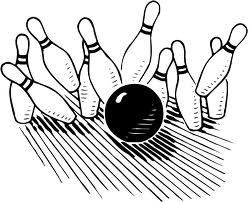
Ten-pin bowling involves rolling a heavy ball down a long, narrow lane in an attempt to knock down ten pins arranged in a triangle at the far end. It is played casually in bowling centres around the world and competitively at national and international level.
Objective
The aim is to knock down as many pins as possible over the course of a game, recording the highest score, or to beat an opponent directly in match-play formats used in professional competition.
Rules and regulations
- World Bowling, known as the Fédération Internationale des Quilleurs or FIQ until it was renamed in 2014, is the sport’s international governing body and is recognised by the International Olympic Committee.
- A game is made up of ten frames, and in each one a bowler gets two attempts to knock down all ten pins, except in the tenth frame, where a strike or spare earns an extra roll.
- Knocking down all ten pins with the first ball is a strike, and knocking down the remainder with the second ball is a spare.
- Bowlers must release the ball without stepping over the foul line at the end of the approach, or the delivery counts as zero regardless of how many pins fall.
- World Bowling standardises the specifications for lanes, pins, balls and the oil patterns applied to lanes in sanctioned competition.
Equipment and playing area
- A bowling lane is about 18.3 metres (60 feet) long from the foul line to the head pin, and just over a metre wide, flanked on both sides by gutters.
- The lane surface, wood or a synthetic equivalent, is coated with a conditioning oil pattern that influences how the ball curves.
- Pins stand 38.1cm tall and are set up in a triangle at the end of the lane.
- Bowling balls are made from materials such as polyester, urethane or reactive resin, weigh up to 16 pounds (7.26kg), and are drilled with finger holes fitted to each bowler.
Scoring
- A strike scores ten pins plus whatever is knocked down on the next two rolls, and a spare scores ten pins plus the next roll, which rewards consistent follow-up shots as well as the initial strike or spare itself.
- An open frame, where pins remain standing after both rolls, scores only the pins actually knocked down.
- A perfect game, scoring the maximum 300, requires twelve consecutive strikes.
- In India, the sport is run by the Tenpin Bowling Federation, and while it remains a minority pursuit tied largely to bowling centres in the bigger cities, Indian bowlers do compete on the Asian circuit.