
By Rakesh Jha
Two Olympic bronze medals, two Asian Games golds, three Asian Champions Trophy titles in a row and an eighth-place World Cup finish: how far has the Indian hockey revival really gone?
For the best part of four decades, Indian men’s hockey lived on memory. Eight Olympic gold medals, the last of them in Moscow in 1980, and a single World Cup title won in Kuala Lumpur in 1975 were recited so often that they began to sound like an excuse for the present. India missed the Beijing Olympics in 2008 altogether and finished last of 12 teams at London 2012.
The past five years have changed the conversation. Since August 2021 the men’s team has won two Olympic bronze medals, the 2025 Asia Cup, two Asian Games golds and three Asian Champions Trophy titles in a row. The question worth asking is whether this is a purple patch built around one strong generation, or the start of something that lasts.
The Olympic medals
Tokyo was the turning point. On 5 August 2021 India came back from 3-1 down to beat Germany 5-4 in the bronze-medal match, the country’s first Olympic hockey medal in 41 years.
Paris showed it was no one-off. India beat Australia 3-2 in the group stage, their first Olympic win over Australia since Munich 1972. In the quarter-final against Great Britain, Amit Rohidas was sent off in the 17th minute. India played the rest of the match with ten men, held on at 1-1 and won the shootout. They lost the semi-final to Germany, then beat Spain 2-1 for bronze, with captain Harmanpreet Singh scoring both goals. India had not won medals at successive Olympics since 1968 and 1972.
Ruling Asia
At the Hangzhou Asian Games, the 2022 edition held in 2023, India beat Japan 5-1 in the final. In September 2025 they won the Asia Cup in Rajgir, Bihar, beating South Korea 4-1 in the final to qualify for this year’s World Cup.
At Aichi-Nagoya this autumn they won all four pool matches, including a 16-1 rout of Sri Lanka. They edged Pakistan 4-3 in the semi-final, Abhishek scoring in the last minute, and beat Malaysia 5-1 in the final on 3 October. It was India’s fifth Asian Games men’s hockey gold, after 1966, 1998, 2014 and 2023, and the first time they had defended the title. It also brought direct qualification for the Los Angeles 2028 Olympics. The women’s team beat China 1-0 for its own gold, so for the first time both Indian sides won hockey gold at the same Games.
A month later, in front of home crowds in Punjab, India won the Asian Champions Trophy for the third edition running. They won all five league matches and beat South Korea 8-1 in the semi-final in Mohali. In the final on 5 November, Kazumasa Matsumoto put Japan ahead in the third minute and they still led at half-time, before India scored four times to win 4-1. That made six titles for India, after 2011, 2016, 2018 (shared with Pakistan), 2023 and 2024. Japan have now lost three finals, in 2013, 2021 and 2026.
The World Cup reality check
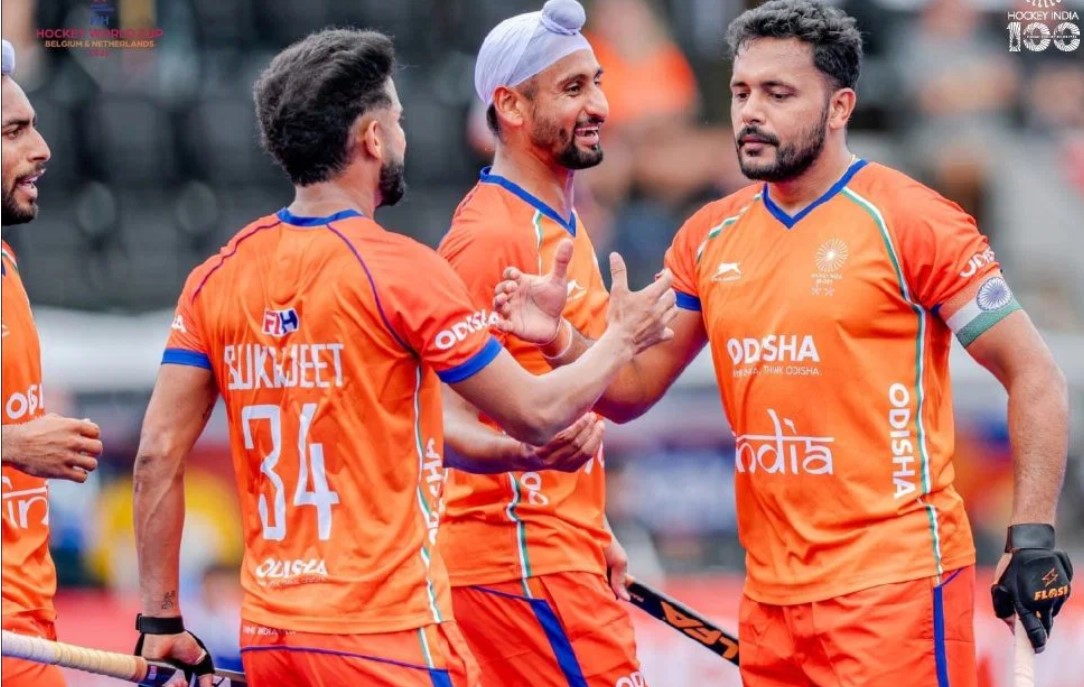
The World Cup in Belgium and the Netherlands in August told a different story. India beat Wales 3-1 and Pakistan 5-3 but lost 4-2 to England after leading 2-1 at half-time. In the second round they lost 3-1 to the Netherlands and 5-3 to Argentina and finished bottom of their group. They then drew 3-3 with Belgium in the match for seventh place and lost the shootout. Germany beat Spain 1-0 in the final to keep the title.
Eighth place matched India’s world ranking going in, and they are still eighth, with 3,072 points to Germany’s 3,720. They remain the highest-ranked team in Asia.
What changed
Much of it began with coaching. Graham Reid, the Australian who took over in 2019, built a fitter, more organised side and was named FIH Coach of the Year after Tokyo. He resigned after India finished ninth at the home World Cup in 2023. Craig Fulton, the South African who replaced him that year, has since taken the team to the Paris bronze and every Asian title listed above.
The temperament has changed too. This team came from two goals down in Tokyo, survived 43 minutes with ten men in Paris and turned round a half-time deficit in Mohali last week.
The player base has widened as well. Punjab still supplies a large share of the squad, and the tribal belt of Odisha and Jharkhand keeps producing players such as Shilanand Lakra from Sundargarh, who scored twice in the semi-final against South Korea and again in the final. The Hockey India League returned for the 2024-25 season after a seven-year break, and more than 1,000 players registered for it. Shrachi Rarh Bengal Tigers won that first revived edition. In January this year Vedanta Kalinga Lancers beat Ranchi Royals 3-2 in the final in Bhubaneswar and took Rs 3 crore in prize money. The FIH has sanctioned the league for ten years, so young Indians now get regular matches with and against overseas players at home.
The players who defined the era
Harmanpreet is the outstanding name. He was FIH Player of the Year for 2020-21, 2021-22 and 2024, and finished the Paris Olympics as top scorer with ten goals. This year alone he scored twice in the Asian Games final and twice against Pakistan at the World Cup, and hit a hat-trick against Malaysia in Jalandhar.
PR Sreejesh retired after Paris with three FIH Goalkeeper of the Year awards, for 2020-21, 2021-22 and 2024. Krishan Bahadur Pathak has since taken the gloves. Hardik Singh, the vice-captain, was FIH Player of the Year in 2023, so an Indian held that award for four editions in a row until Belgium’s Tom Boon won it in 2025. Abhishek has become the forward India look to in tight matches: he scored against Australia in Paris, got the late winner against Pakistan in Aichi-Nagoya and scored twice against them again at the World Cup.
The support behind the team
None of this happened without money. The Odisha government took on sponsorship of the men’s and women’s national teams, senior and junior, in 2018. In April 2024 it extended the deal to 2033 at a cost of Rs 434.12 crore, and the new government under Mohan Charan Majhi then pushed it further, to 2036. Odisha also hosted the men’s World Cups of 2018 and 2023 in Bhubaneswar and Rourkela, and Rourkela staged the Indian leg of the FIH Pro League this February.
Other states are now joining in. Bihar hosted the 2025 Asia Cup in Rajgir. The Asian Champions Trophy was played in Jalandhar and Mohali, and the semi-final against South Korea was the first international match at Mohali’s Olympian Balbir Singh Senior International Hockey Stadium. Punjab is now bidding to host the 2030 men’s World Cup.
Behind the players sits a support staff of analysts, physios and conditioning specialists that earlier generations did not have.
What comes next
India are the best team in Asia by some distance and a podium side at the Olympics, but not yet a regular contender for the biggest titles. The only men’s World Cup title is still the one from 1975, and the gap to Europe’s best showed again in August.
Winning the Asian Games means India will not need a qualifying tournament for Los Angeles. That frees the next two years for what Asia cannot provide: more matches against Germany, the Netherlands, Belgium, Spain, England, Australia and Argentina, and a squad deep enough to cope when Harmanpreet’s penalty corners are not going in.
The junior results give some cause for hope. With Sreejesh as coach, the under-21 side won bronze at the 2025 Junior World Cup in Chennai, coming from 0-2 down to beat Argentina 4-2 for India’s first podium at the event since 2016. Hockey India has since handed the job to France’s Frédéric Soyez. This year the under-18 team won the Asia Cup in Kakamigahara, beating Japan 4-1 in the final with a hat-trick from Ashish Tani Purti.
Several of the Tokyo group are now in their thirties. Whether this era becomes something lasting will depend less on the next Asian title than on whether the players coming through can beat Germany, the Netherlands and Belgium when it counts at a World Cup.